
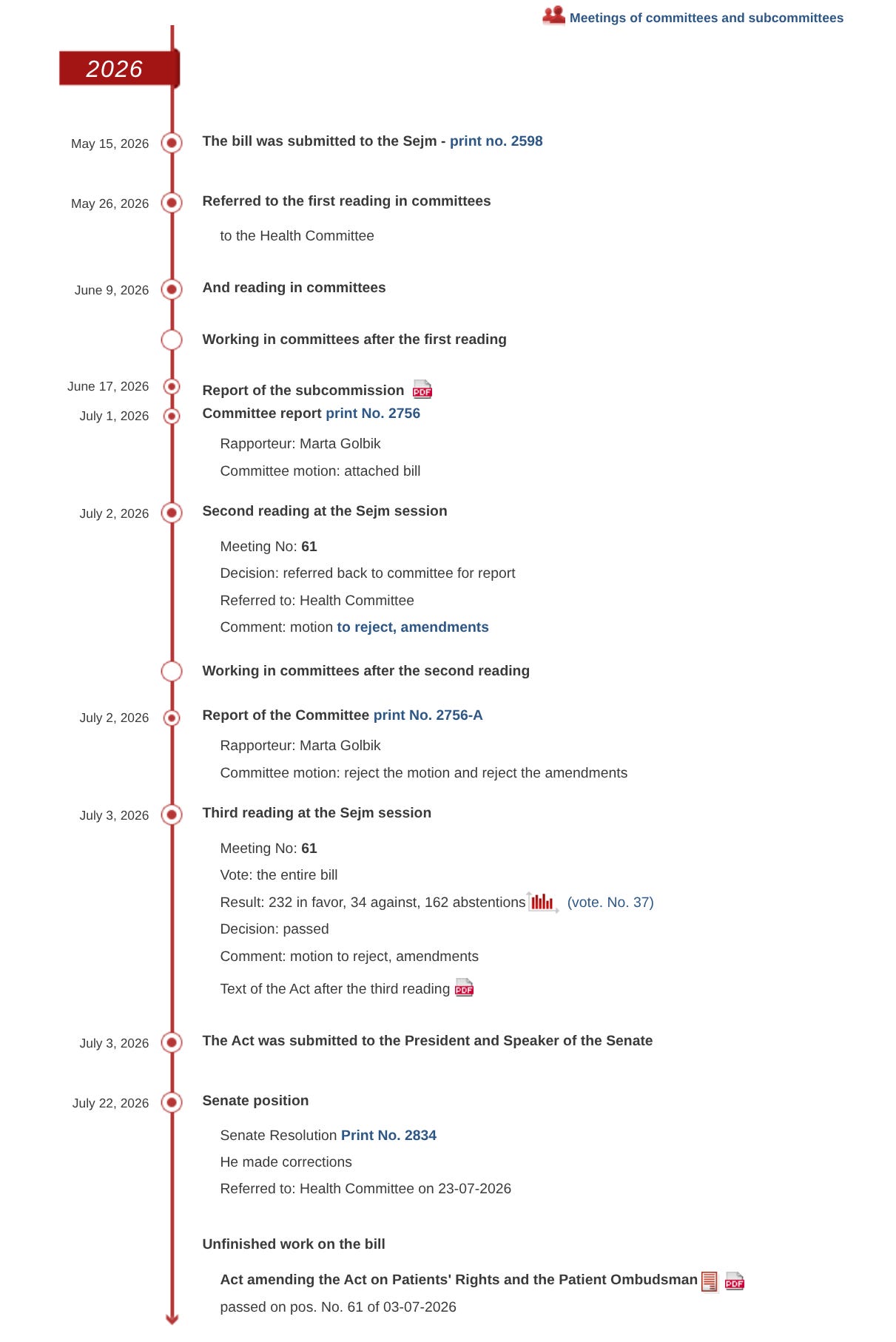
Poland's lower house (Sejm) has already passed the legislation known as "Lex Szarlatan." The bill is now approaching the President's desk, making this one of the last opportunities to prevent it from becoming law.
In its present form, the bill threatens the livelihoods of thousands of conscientious naturopaths, herbalists, and complementary therapists while restricting patients’ long-standing right to choose approaches that support their health outside the narrow confines of conventional medicine.
It is presented as a campaign against “charlatans,” “disinformation,” and “pseudo-medicine.” However, recent years have demonstrated how readily governments and regulatory bodies misclassify legitimate scientific disagreement and evolving evidence under precisely these labels. The legislation therefore risks becoming a weapon against an entire tradition of natural and integrative care.

Help Resist This Legislation
A joint petition from organizations across the medical, scientific, and complementary-medicine communities has been prepared in opposition. If you have an organization and wish to oppose this bill, you can send the following document signed to the official address of the Chancellery of the President of Poland: listy@prezydent.pl
The petition organizers would also be grateful if you are able to send a copy of the communication to kontakt@przywrocenie.org so they can keep track of the support received.
We have also produced an open letter for the Polish president imploring him to stop this legislation:

A Dangerous Expansion of State Power
The draft legislation advanced by Poland's Minister of Health and adopted by the Council of Ministers is a mechanism of pre-emptive control that will almost certainly treat legitimate disagreement as though it were a crime. Under the guise of protecting patients, it arms a single administrative office with the power to silence, fine, and publicly brand practitioners whose methods or statements fall outside today's highly manufactured consensus.
Interim Orders, Major Fines, and Public Stigma
The draft is centred on identifying and punishing individuals seen to be engaging in newly prohibited conduct. It authorizes interim orders requiring the immediate cessation of activities before any formal proceedings have concluded, increases the maximum fine for violating collective patient rights from 500,000 zloty (approximately CAD $185,000) to 1 million zloty (approximately CAD $370,000), doubles the penalty for failing to cooperate with the Patient Rights Ombudsman to 100,000 zloty (approximately CAD $37,000), and requires decisions to be published publicly (with patient-identifying information removed). The legislation is scheduled to take effect just three months after publication in the Journal of Laws.
Many long-standing complementary practitioners have never registered as medical-activity entities precisely because they do not present themselves as physicians. The draft transforms that technical distinction into a liability for practitioners. Combined with public warnings, immediate suspension of activities, and the publication of enforcement decisions against similar practitioners, it may produce a chilling effect. Even practitioners ultimately cleared of wrongdoing are likely to suffer lasting reputational damage. When an interim order can shut down a practice overnight and a one-million-zloty fine hangs over any subsequent finding, silence or inaction becomes the safest course. This concern becomes even clearer when examining the legislation’s definitions.
Definitions Open to Overreach
The legislation defines “pseudo-medical practice” so broadly that many of its prohibited activities are open to wide interpretation. It includes conduct such as:
Any activity that “may endanger the health or life of patients.”
Offering methods that lack scientific confirmation.
Discouraging patients from using therapies consistent with current medical knowledge.
Attributing medicinal properties to methods that are not healthcare services.
The phrase “may endanger the health or life of patients” is inherently subjective and expansive. Nearly any intervention, including widely accepted medical treatments, carries some degree of risk. Without clear criteria, this standard could be applied inconsistently, potentially penalizing practitioners who engage in legitimate but unconventional approaches or who tailor treatments to individual patient needs.
The requirement for scientific confirmation presents another major complication because governments, regulators, and professional bodies often converge around a single official narrative while dismissing competing interpretations as “misinformation” or “disinformation.” Scientific understanding develops through continual testing and revision, not administrative dogma. Turning the prevailing consensus into a legal standard risks replacing open scientific inquiry with regulatory conformity.
The notion of “discouraging” conventional therapies also raises serious concerns. Practitioners have a duty to inform patients about risks, side effects, and alternative options. Honest discussions about treatment limitations, complementary approaches, or a patient’s informed decision to decline treatment could all be interpreted as discouragement, even when they are essential to responsible, patient-centred care and genuine informed consent. This ambiguity risks stunting open communication between practitioners and patients.
Finally, restricting claims about complementary therapies or natural health products overlooks the complexity of healthcare choices. Many patients seek integrative approaches, and some complementary methods have demonstrated benefits in certain contexts. Prohibiting discussion or acknowledgment of these options may limit patient autonomy and access to a broader range of care strategies.
Scientific understanding advances through open inquiry and the continual testing of accepted ideas. Entrenching today’s consensus in law, enforced through administrative sanctions, risks suppressing the very process by which medical knowledge improves.
The Weaponization of “Disinformation”
The same vague language appears in the provisions concerning "medical disinformation" linked to “financial or personal gain.” Recent years have shown how regulators are able to treat evolving or dissenting evidence as outright lies long before the issue is settled—and how institutions and officials themselves have made false claims while accusing others of the same thing.
Further “Personal gain,” as distinct from financial gain, risks including anything that passively grows a client base or reputation. This is an extremely low threshold for asserting improper motive.
Concentrated Power and Ordinary Outcomes
Expanding the Patient Rights Ombudsman’s standing in civil proceedings further concentrates power. Under the draft, decisions to impose highly intrusive measures ultimately rest with a single person.
One basis for participation in those proceedings includes cases involving a patient's death during treatment or allegedly resulting from the failure to provide appropriate medical care. Determining whether different forms of care would have made the difference grants extraordinary discretion to those charged with enforcing the law. Clinical medicine is inherently uncertain; patients sometimes die despite receiving the best available care. Using such outcomes as the justification for action against complementary practitioners, without the procedural safeguards ordinarily associated with judicial proceedings, invites selective or overreaching enforcement.
Existing Law Already Targets Real Harm
Existing criminal and consumer-protection laws already prohibit fraud, unauthorized practice of medicine, and advice that demonstrably causes harm. This legislation moves beyond proof of concrete injury and places the weight of the state behind policing acceptable discourse about health. The practical effect will be to harm honest naturopaths, herbalists, and complementary therapists. By making even ethical, conscientious practice legally risky, it reduces options for patients and diminishes long-established freedoms to choose supportive methods outside conventional medicine.
Patient Autonomy Cannot Survive These Criteria
Patient autonomy rests on the premise that informed individuals may weigh risks and benefits according to their own values—including the choice of supportive or complementary approaches alongside, or in some cases instead of, conventional care. When the criteria for "pseudo-medicine" are drafted so broadly that entire traditions of care can become effectively prohibited, real science is abandoned.
The international petition now circulating among medical, scientific, and complementary-medicine organizations recognizes this danger. The President still has the opportunity to reject the bill in its present form. Once the final signatures are affixed, that opportunity will be gone.
Additional Resources
Draft Act amending the Act on Patients’ Rights and the Patient Ombudsman (Page Translator or Polish Language Required): Link
I wish ordinary alternative health professionals from all over the world were able to sign too.
https://townsendletter.com/ Please, human rights all protected: give feed back on Third Stage of Labour rights with a Birth Contracts the rights of all women. July 6, 2026 publication.